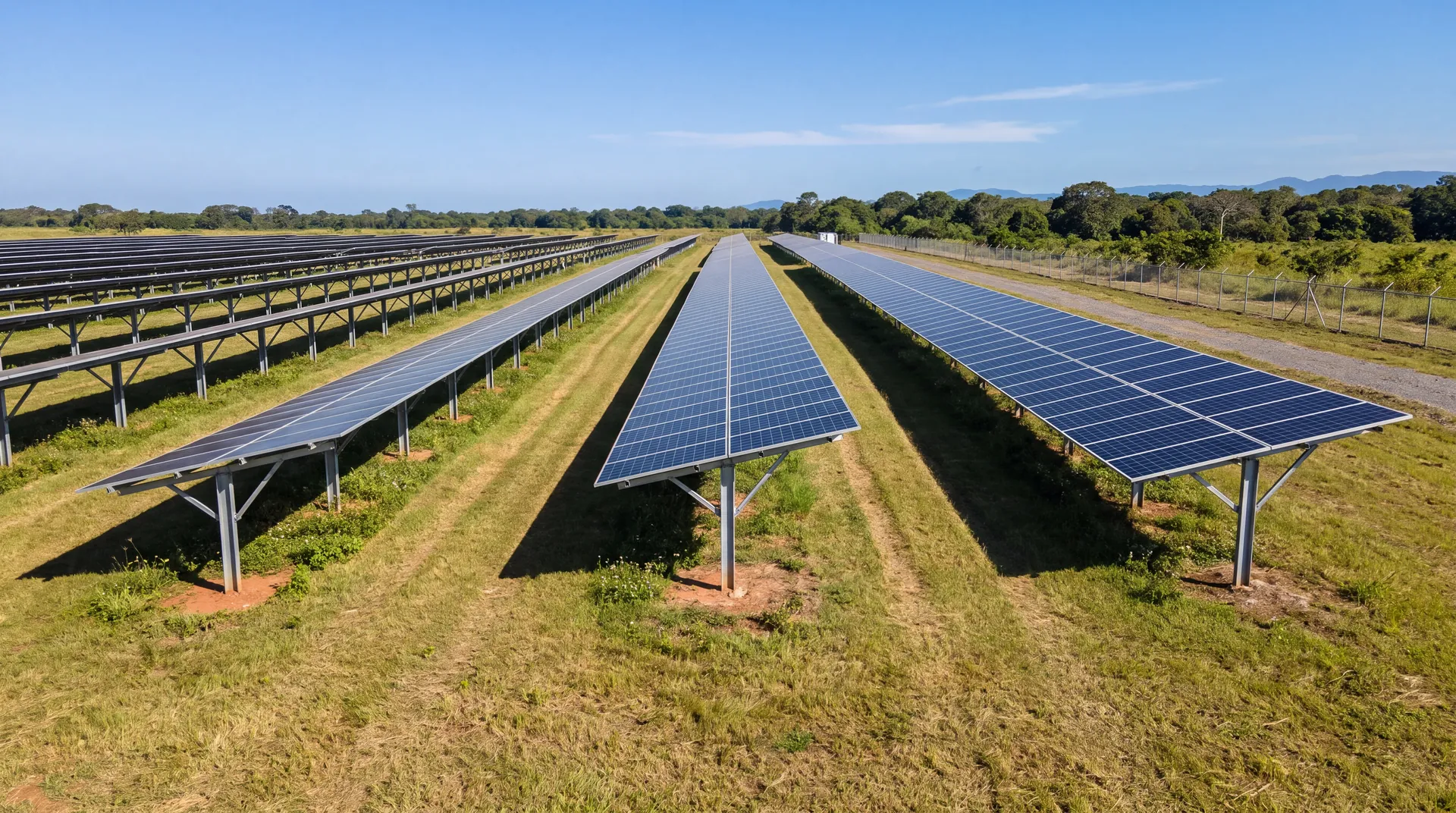
Ground-Mount Solar.
Homestead to Utility Scale.
Visualization
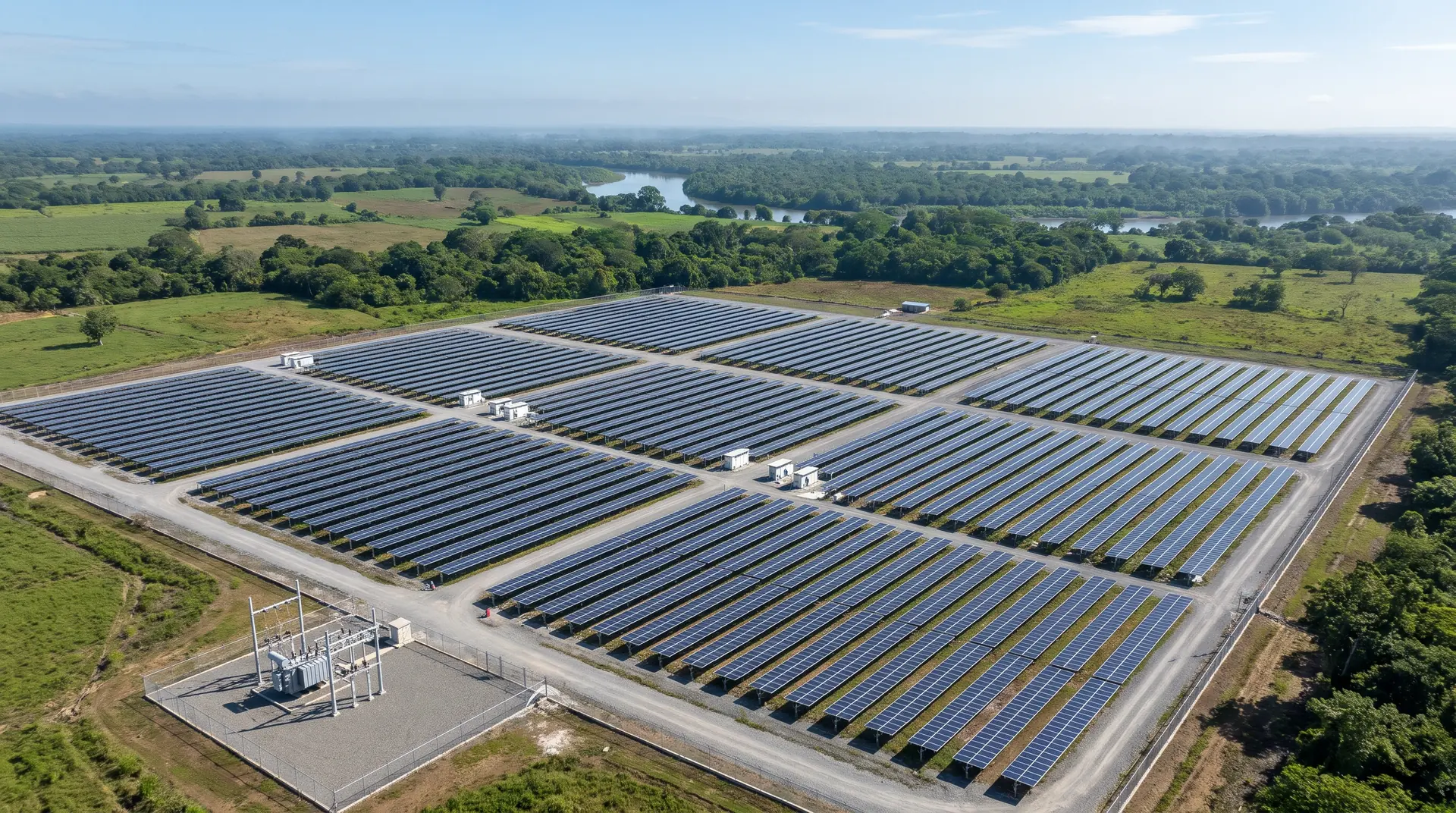
Solar arrays sized to any application.
On open ground the array faces the sun at the right angle, stays open to the breeze, and every part can be reached for cleaning and repair.
- 2.8acres
- The median array area of a fixed-tilt plant for each MW of panels (1.1 ha). Whole sites, roads and fences included, run about 2 to 3 ha a MW
- 30+years
- The life owners plan for a ground plant. 17 of 19 industry groups surveyed assume 30 years or more
- 0.5% a year
- Median loss of module output measured across published field studies
Visualization
We design each array for Belize sun and rain.
Belize sun is strongest from March to May. The rains bring a dip in June and the short days a low at the year’s end, and the year still comes out ahead of Florida.
- Corozal
- 1,480 kWh
- Toledo
- 1,392 kWh
- Cayo
- 1,361 kWh
- Orlando, Florida
- 1,444 kWh
- Munich, Germany
- 1,230 kWh
Source and notesHide source and notes
We design ground mounts for every size of site.
From a homestead’s few kilowatts to a utility plant’s megawatts, the ground work is the same: posts, steel, strings and protection. What changes with size is how the power is collected, converted and stored. Choose a size to see what changes.
- Inverter
- String inverters, up to 330 kVA each
- DC side
- 1,000 to 1,500 V
- Connection
- At low voltage, or at the site’s medium-voltage transformer
Show 2 moreShow less
- Storage
- In Belize, at least 1 hour above 6 kW and 2 hours above 250 kW, when grid-connected
- Control
- Export limits and remote monitoring
Source and notesHide source and notes
Visualization
Single-post frames, built for Belize wind and soil.
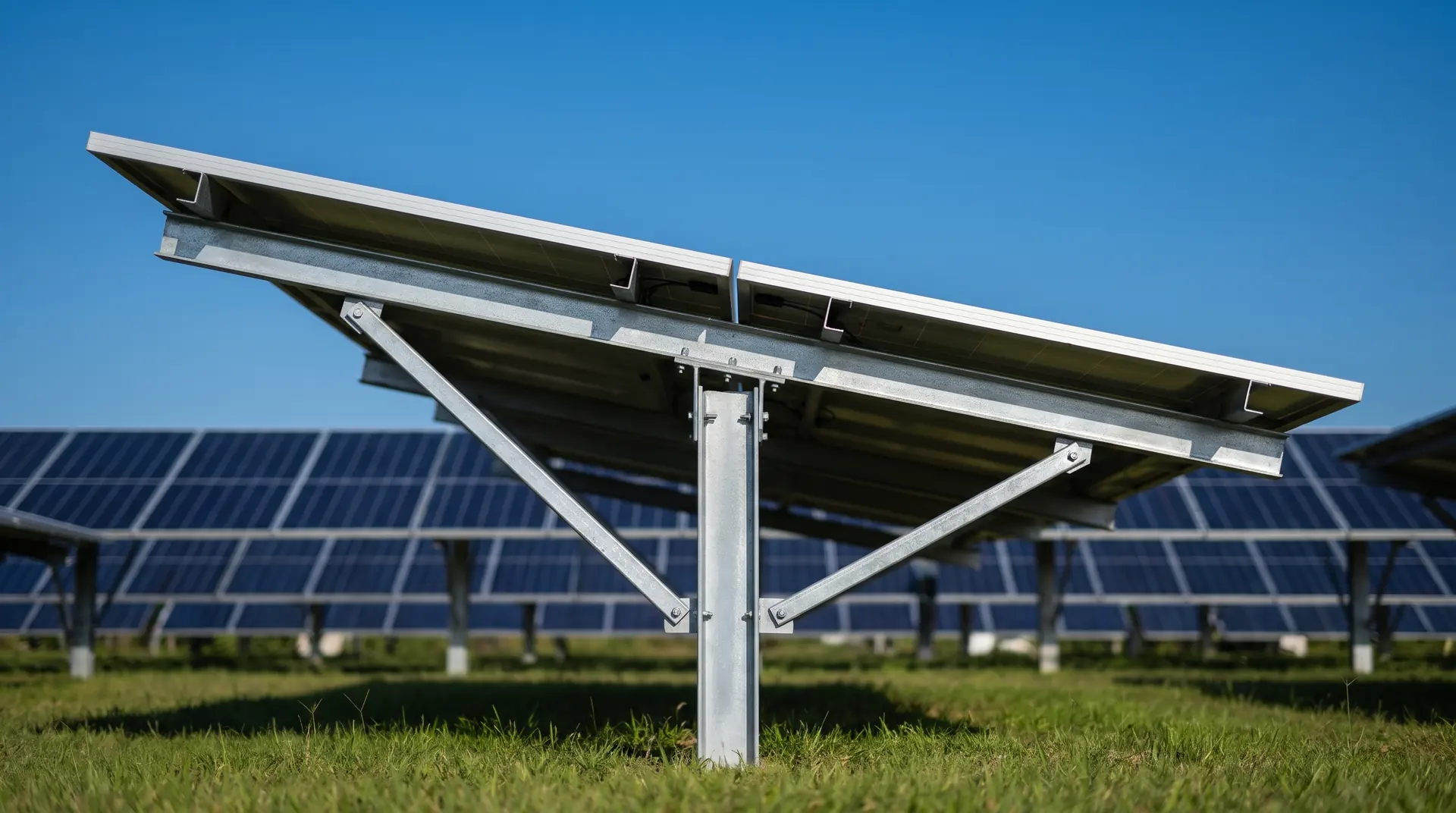
Our standard frame stands on a single post: a sloped beam on top and the modules balanced front and back. Fewer posts to drive, and open ground on both sides for mowers and sheep.
- 1Modules, two highRated for the uplift the wind calculation demands, up to a 5,400 Pa test load.
- 2PurlinsModules bolted through the frame, or held by clamps rated to hold each one alone.
- 3Sloped beamOne per post, set at the design tilt.
- 4Knee bracesStiffen the frame against wind from the front and the back.
- 5Single postHot-dip galvanised steel. One post per frame instead of two.
- 6Driven pile · Soft to firm soilA galvanised steel section driven to the depth the pull-out and sideways tests on site call for.
Single-post system specs
- Frame
- One galvanised post per frame, a sloped beam, knee braces and purlins
- Modules
- Two high in portrait, at the tilt the yield model sets for the site
- Foundations
- Driven pile, ground screw, drilled and grouted, or concrete pier, chosen from tests on site
- Wind design
- ASCE 7 at the site’s design wind speed, the standard behind the Belize Building Code
- Module rating
- Up to a 5,400 Pa test load where the wind calculation needs it
Show 5 moreShow less
- Fixings
- Through-bolted or rated clamps, locked against vibration; no self-tapping screws
- Steel
- Hot-dip galvanised, the coating set by the site’s corrosivity category
- Design life
- 30 years and more
- Warranty
- 10 years on our workmanship; panels and inverters carry their makers’ warranties
- Monitoring
- 24/7 from our operations centre, from switch-on
We test the ground before we design.
Test posts are pulled up and pushed sideways on the site, in steps, until they move. Soil samples set the coating, and on limestone the ground is probed for voids.
We switch to two posts where needed.
Where the wind exposure or the soil calls for it, we design a two-post frame. In the 2017 Caribbean hurricanes, the ground mounts that survived stood on two posts.
Source and notesHide source and notes
We design every joint for hurricane wind.
Five hurricanes have crossed the Belize coast since 2001. In the 2017 Caribbean storms, arrays failed at their weakest joints, so every joint is designed to the wind.
- 1961HattieNear Mullins RiverCat 4
- 1978GretaNear DangrigaCat 2
- 2000KeithOver the northern cayesCat 3
- 2001IrisMonkey River TownCat 4
- 2010RichardGales PointCat 2
- 2016EarlSouth of Belize CityCat 1
- 2020NanaSittee PointCat 1
- 2022LisaSibun River mouthCat 1
Source and notesHide source and notes
Where arrays failed, and what we do
- Module fixings
- Modules bolted through the frame, or held by clamps rated to hold each module alone
- Bolts and screws
- Bolts sized, torqued and locked against vibration. No self-tapping screws
- Module rating
- Modules rated for the uplift the calculation demands, up to a 5,400 Pa test load
Show 2 moreShow less
- Bracing
- Bracing checked by the engineer for wind from every side
- Calculations
- Wind loads to ASCE 7, the standard behind the Belize Building Code (2025)
Source and notesHide source and notes
We choose fixed or tracking on yield, cost and wind.
A tracker turns the panels to follow the sun and makes more energy than a fixed frame. It also costs more to build and to keep, takes more land, and must stow in high wind. Most large plants track; most smaller ground mounts stay fixed.
- Energy, Belize CityA year, per kWp of panels
- Fixed tilt: 1,548 kWhTracking: 2,035 kWh
- Cost to buildPer watt of panels, like-for-like US model (fixed = 100)
- Fixed tilt: 100Tracking: 107
- UpkeepA year, per kW of panels, same model (fixed = 100)
- Fixed tilt: 100Tracking: 110
- LandArray area per MW of panels, US medians
- Fixed tilt: 2.8 acresTracking: 4.2 acres
- Energy per acreA year, US medians
- Fixed tilt: 447 MWhTracking: 394 MWh
What tips the choice
- Size
- Large plants usually track; smaller ground mounts rarely do. In US data, trackers are on 92% of new utility plants but on only 1–9% of large commercial systems a year.
- Cost
- About 7% more to build than fixed frames in a like-for-like model; on recent US plants the gap has closed. The yield model weighs it against the extra energy.
- Upkeep
- Motors, drives and controllers to maintain: about 10% more a year in the same model.
Show 2 moreShow less
- Land
- Rows sit further apart so they don’t shade each other as they turn, so a fixed array makes more energy per acre.
- Wind
- A tracker must stow before the wind peaks, and each maker stows differently. In Category 4 and 5 wind zones, RMI recommends fixed tilt.
Source and notesHide source and notes
We set the steel coating by the distance to the sea.
Sea salt is carried inland, and zinc wears fastest near the surf. We specify the coating for the site’s corrosivity and the life the plant needs.
- CX
- Extreme · Within 100 m8.4–25 µm of zinc a year3–10 years for an 85 µm coat
- C5
- Very high · 100–500 m4.2–8.4 µm of zinc a year10–20 years for an 85 µm coat
- C4
- High · 0.5–1 km2.1–4.2 µm of zinc a year20–40 years for an 85 µm coat
- C3
- Medium · 1–10 km0.7–2.1 µm of zinc a year40–100+ years for an 85 µm coat
Source and notesHide source and notes
We lay out the whole site, not just the rows.
Drainage, cable routes, earthing, security and ground cover are designed in from the first layout.
- Panel rows
- Road and gate
- Cable route
- Drainage
- Fence
- Camera
- 1Rows on single postsSpaced so no row shades the next, with room to mow or graze between them.
- 2DrainageSwales and a basin carry the runoff. Belize gets about 1,500 mm of rain a year in the north and 4,000 mm in the south.
- 3Cable routesBuried below code depth, or carried on the racking, clear of mowers.
- 4Inverters and transformerOn a raised pad. The lowest panel edge and every piece of electrical gear sit above the 100-year flood level.
- 5Battery storageSized to the site. When grid-connected in Belize: at least 1 hour above 6 kW, 2 hours above 250 kW.
- 6Earthing and lightningAll racking bonded into one earth mesh, designed to the soil. Protection set by an IEC 62305-2 risk assessment.
- 7Fence, gate and camerasCopper earthing cable is the most stolen part of a solar farm, so the site is designed to deter, delay and detect.
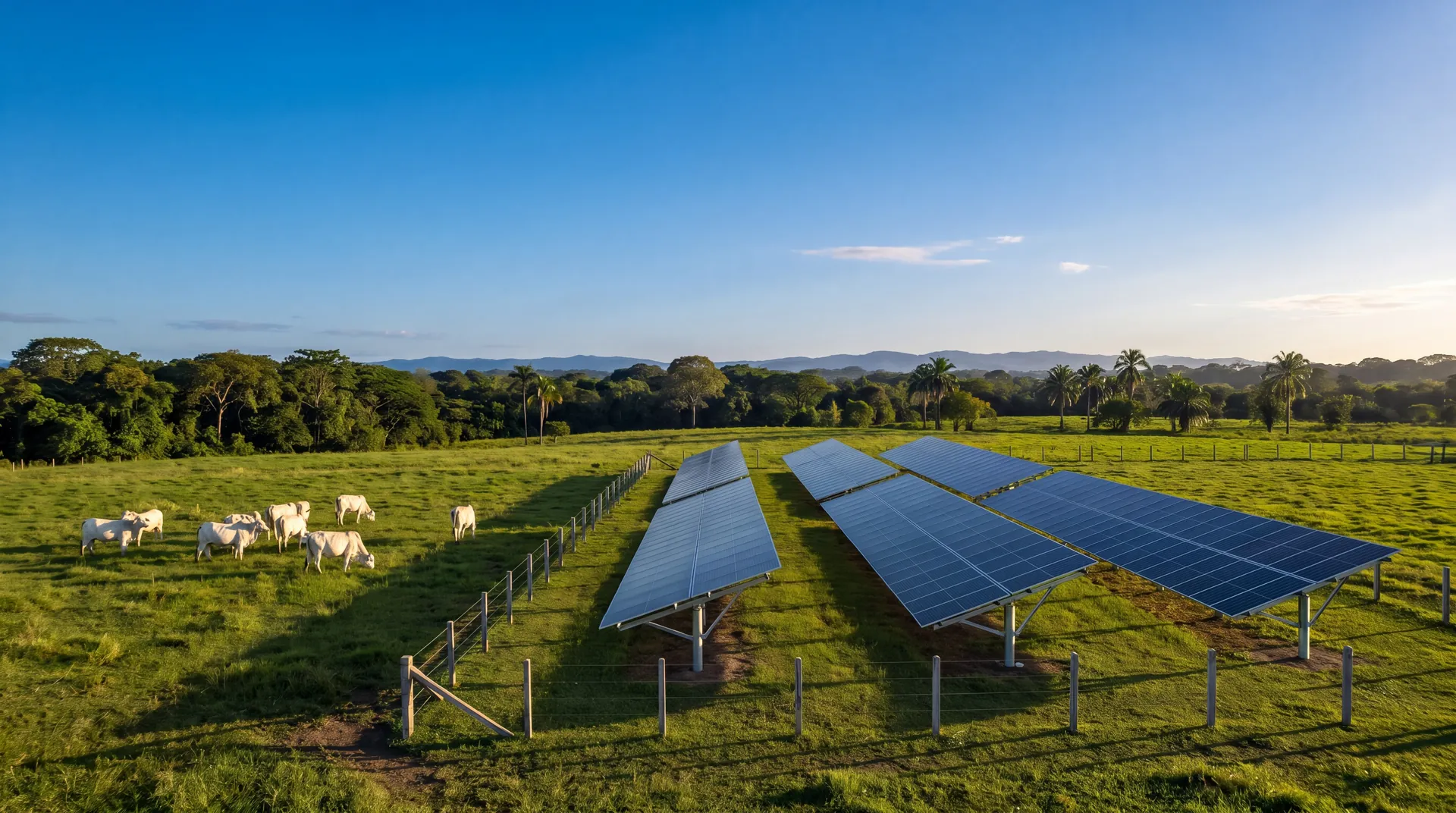
- 8Ground coverSheep graze under standard arrays. Cattle need taller frames.
Source and notesHide source and notes
Visualization
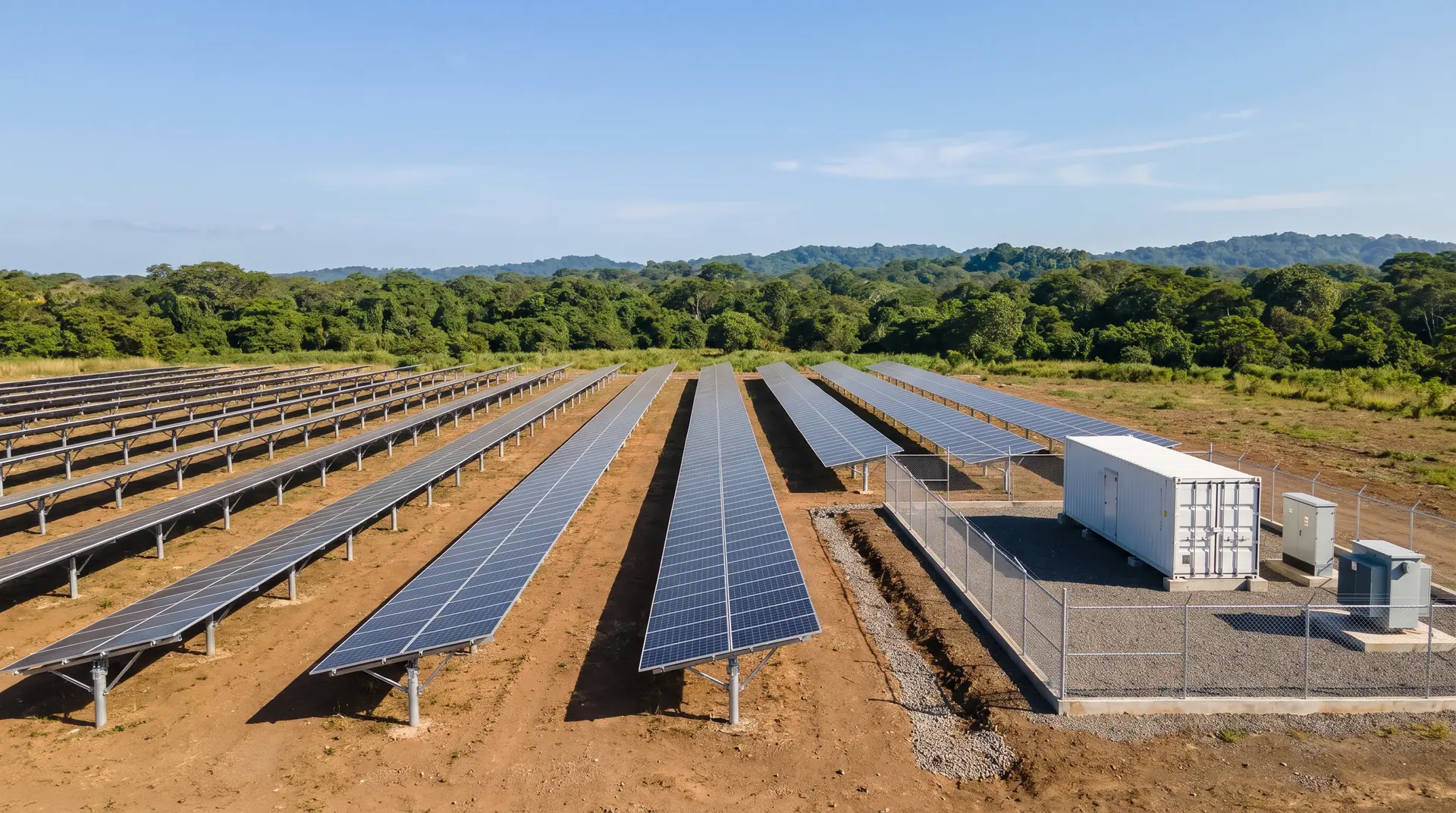
We build solar, battery and generator as one plant.
Above 6 kW, a plant on the grid in Belize must carry a battery, and an off-grid site needs one anyway. We design the array, the battery and the generator together. How the storage works is on our storage pages.
We match each plant to its Belize licence class.
The PUC sets the licence a plant needs, and the storage it must carry, by its size and by whether it connects to BEL. The limits apply to AC output.
- Off grid, up to 75 kWNo licence or consent; the PUC may ask you to registerSized for the nights and the cloudy days
- Off grid, above 75 kWSelf-generation, licensed or consented by size classMay be designed for up to three days on its own
- On the grid, up to 6 kWDistributed generation, minorOptional
- On the grid, above 6 kW to 250 kWDistributed generation, intermediateAt least 1 hour
- On the grid, above 250 kW to 1 MWDistributed generation, majorAt least 2 hours
- Above 1 MW, selling to BELIndependent power producer, through BEL and the PUCSet by the tender; the 15 MW Corozal plant has a 3 MWh battery
Source and notesHide source and notes
Visualization
Six steps from first visit to switch-on.
One team runs the project, from the first site visit to remote monitoring.
- 01
Assess
- Site visit and survey
- Flood and drainage review
- Your bills or load list
- 02
Test the ground
- Pull-out and sideways post tests
- Soil corrosivity
- Voids probed on limestone
- 03
Design
- Yield model and layout
- Structure to ASCE 7
- Electrical, protection and earthing
- 04
Permit and procure
- Permits and utility interconnection
- Modules, racking, inverters and storage
- 05
Build and commission
- Piling and assembly
- Cabling and earthing
- Tests to IEC 62446-1
- 06
Monitor and maintain
- Remote monitoring
- Planned maintenance and cleaning
NotesHide notes
Commissioning follows IEC 62446-1, with I-V curve tests and infrared thermography (IEC TS 62446-3) on larger plants, and a capacity test to ASTM E2848 where the contract calls for one.
What you get.
A 10-year warranty on our work, monitoring around the clock from switch-on, and our own team in Belize to call.
- Warranty
- 10 years on our workmanship. Panels carry their makers’ 25 to 30 year power warranties, and inverters their makers’ warranties, often extendable.
- Design life
- 30 years and more. The US Energy Information Administration models a solar plant at 35 years.
- Monitoring
- 24/7 from our operations centre, from switch-on, with a 15-minute response target.
Show 4 moreShow less
- Who to call
- Our own team in Belize: +501 630 1196
- Build time
- Days on site for a homestead, weeks for a farm or business, about a year for a utility plant. We give the schedule with the design.
- Financing
- DFC Sustainable Energy Loans: 6% on the reducing balance, up to BZ$300,000, over up to 22 years. Belize Bank also finances renewable projects for small businesses.
- Maintenance
- Planned visits for cleaning and vegetation, and a yearly check of bolts, earthing and inverters.
Source and notesHide source and notes
How long a build takes
- Homestead1–5 days on site · 60–90 days in all
- Farm or business1–6 weeks on site · 7–10 months in all
- 1 to 10 MW9 weeks to 9 months on site · 20–34 months in all
- Utility plant6–12 months on site · 3–5 years in all
Source and notesHide source and notes
What owners ask us.
Single post or two posts?
Our standard frame stands on one post: fewer piles to drive and open ground for mowing and grazing. Where the wind exposure or the soil calls for it, we design a two-post frame. In the 2017 Caribbean hurricanes, the ground mounts that survived stood on two posts (RMI).
Fixed tilt or tracker?
Trackers make more energy, but cost more to build and to keep, need more land and must stow in high wind. Most large plants track and most smaller ground mounts stay fixed. We model both for your site, its size and its wind before choosing.
Do I need a battery?
In Belize, a grid-connected system above 6 kW must include at least one hour of storage, and above 250 kW at least two hours (PUC, Capacity Limits Order 2026). Off-grid systems carry a battery anyway.
What does the ground test involve?
Test posts are pulled up and pushed sideways in steps until they move (ASTM D3689 and D3966). Soil samples are tested for pH, chloride, sulfate and resistivity, which set the steel coating. On limestone, the ground is probed for voids.
How long does it last?
Owners plan 30 to 35 years for a ground plant. Our warranty runs 10 years, and the panels carry their makers’ 25 to 30 year power warranties, losing about 0.5% of their output a year (NREL median). Inverters are usually replaced once in the plant’s life.
Can animals graze under it?
Sheep graze under standard arrays and keep the grass down. Cattle need taller frames built for them. Crops under the panels need about 2 m of clearance or more.
Navigating Belize’s Energy Landscape
Belize’s energy rules are changing fast. Our engineers are fully licensed, and our established partnerships keep each project in step with every change, so our clients’ projects are delivered with ease.
PUC Licensed
Titanium Energy’s engineers are fully licensed by the Public Utilities Commission. Every system we build meets Belize’s grid and safety requirements as they stand today.
PUC Collaboration
We work directly with the PUC from feasibility studies to final interconnection approval, so each new rule is part of our clients’ projects from the start.
BTB Partnership
For resort and tourism projects, we coordinate closely with the Belize Tourism Board to align each installation with tourism development and national sustainability priorities.
Cross-Agency Coordination
Our working relationships with the energy ministry, the environment and lands departments and municipal authorities keep permits moving as the rules change.
“For foreign investors and developers, navigating Belize’s regulatory environment can be the biggest project risk. Our established relationships turn that risk into a managed process.”
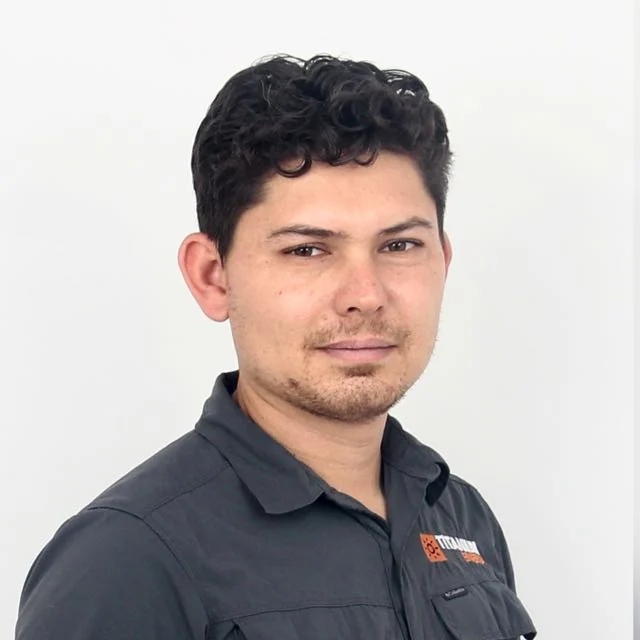 Jakob WoodruffCEO
Send us your site.
Five facts are enough for a first answer: what fits the land, roughly how big, and what to test next.
- 01Where the site is; a map pin is enough
- 02How much land, and whether it floods
- 03What it will power: bills or a load list
- 04Grid, generator or off grid
- 05Anything known about the soil or rock